Website Security

Website Security

Every website deserves a trusted, encrypted connection

Certificates and management tools

TLS/SSL Certificates

Encrypt and authenticate your websites and services under a publicly trusted root. Four validation tiers cover every use case: DV, OV, EV, and Wildcard. 


ACME

Fully automated certificate issuance, renewal, and revocation via RFC 8555 ACME protocol. 


CLM

Integrate SSL.com as a CA into your CLM platform — Venafi TPP or Keyfactor Command — for fleet-wide certificate discovery, inventory, and lifecycle management.

Smart SeaL

Dynamic site seal displaying real-time certificate status, validation level, and trust indicators for customer-facing websites. 

SSL Manager

Free Windows desktop application for ordering, installing, renewing, and managing SSL.com certificates without command-line tools, MMC snap-ins, or IIS reconfiguration. 
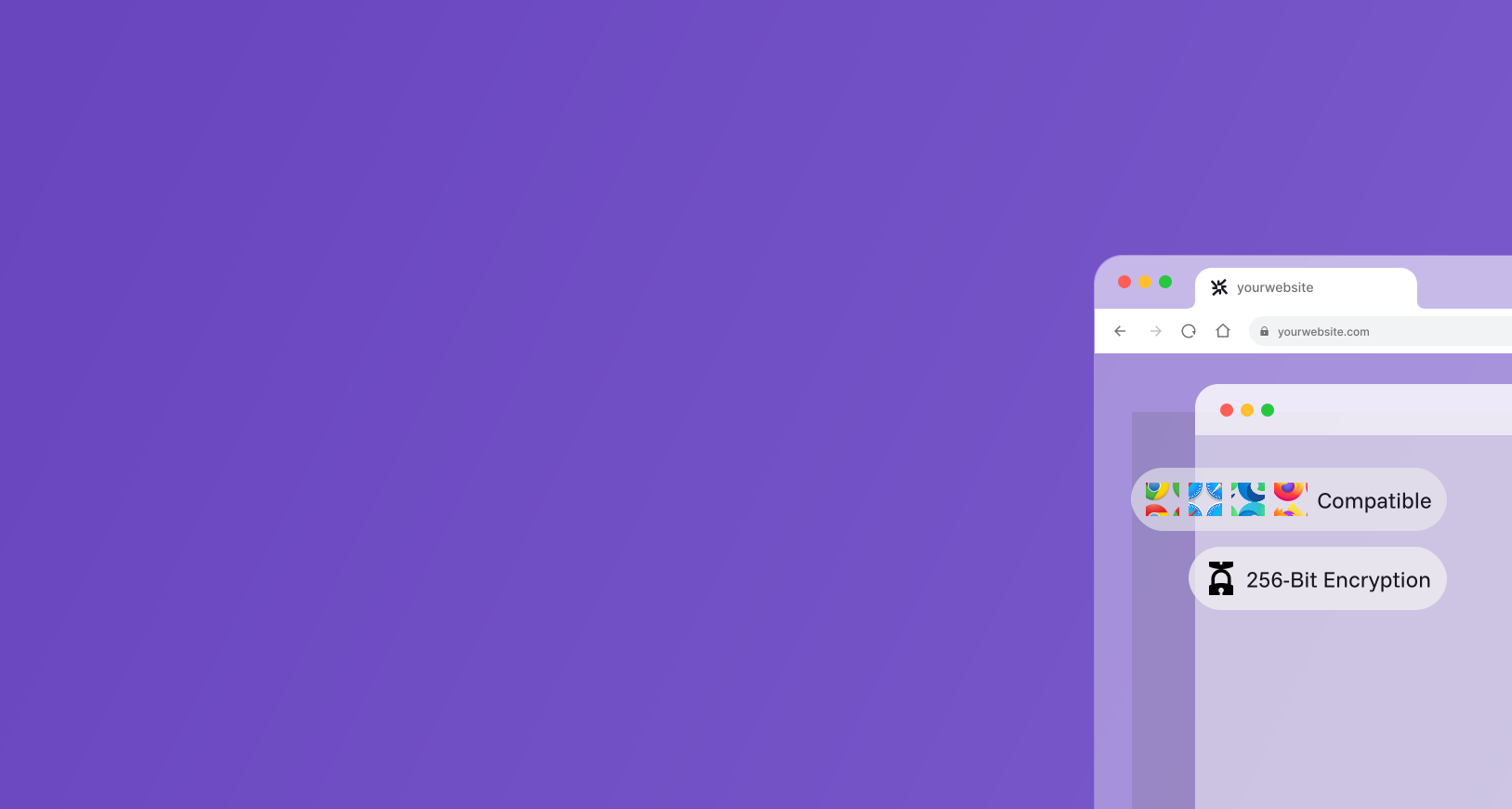
TLS/SSL certificates from SSL.com encrypt communications between your servers and visitors, authenticate your website’s identity, and keep your customers’ data private. 

Certificate lifetimes are shortening: automation is becoming essential

Effective March 11, 2026, maximum TLS/SSL certificate lifetimes reduced to 200 days. Apple has proposed further reductions toward 47 days in the coming years, with CA/B Forum approval already obtained. Organizations with large certificate fleets face dramatically more frequent renewals. Manual certificate management at scale is increasingly unsustainable. ACME-based automation and tools like SSL Manager are moving from convenience to operational necessity.

SSL.com provides both the certificates and the automation tools to manage them efficiently: no matter your scale. With certificate lifetimes now capped at 200 days and continuing to shorten, automated lifecycle management is no longer optional.

Compare SSL certificate types: DV, OV, and EV

Question 1
How many domains do you need to secure?
Question 2
What level of identity validation do you need?
EV is not available for wildcard certificates per CA/B Forum rules.
Your recommendation
Single Domain Certificate
Secures exactly one domain or subdomain. Available in DV and OV validation levels.
View Single Domain →
Enterprise EV Single Domain
Full Extended Validation for one domain. Organization identity embedded in the certificate. $1,750,000 warranty.
View Enterprise EV →
Wildcard Certificate
Secures your domain and every first-level subdomain (*.yourdomain.com). Available in DV or OV.
View Wildcard →
Multi-Domain (UCC/SAN) Certificate
Up to 500 domain names in one OV certificate. Ideal for multi-property organizations and Microsoft Exchange.
View Multi-Domain →
Enterprise EV UCC/SAN
Full Extended Validation across up to 500 domains. Organization identity embedded. $1,750,000 warranty.
View Enterprise EV UCC/SAN →
Managing many certificates? Add ACME automation to eliminate manual renewals. With lifetimes at 200 days and shrinking, automation prevents outages.
↻ Start over

Trusted by organizations of every size: since 2002

WebTrust for CA

Annual WebTrust audits by BDO cover CA operations, Baseline Requirements SSL, and Network Security: the continuous independent assurance required by all major browser root programs. SSL.com has maintained unbroken audit coverage since 2002.

CA/B Forum compliant

Every public TLS certificate is issued under current CA/Browser Forum Baseline Requirements with all ballot resolutions applied: aligned with Microsoft, Apple, Google, and Mozilla root program policies to ensure certificates work in every modern browser and operating system.

ACME Protocol (RFC 8555)

Full RFC 8555 ACME v2 implementation for automated certificate issuance and renewal at production scale. No artificial rate limits: the foundation for large certificate fleets facing 200-day (today) and 47-day (future) lifetime requirements.

Frequently asked questions

All three provide the same TLS encryption strength, the difference is how thoroughly your organization's identity is verified before issuance. DV (Domain Validation) confirms control of the domain and typically issues in minutes. OV (Organization Validation) verifies your legal business identity against independent sources; the validated organization name appears in certificate details. EV (Extended Validation) applies the strictest identity verification under CA/Browser Forum EV Guidelines, used for high-trust sites where visible verified identity matters. Choose DV for developer and internal sites, OV for commercial business sites, and EV for financial services, government, and any site where the visitor should see cryptographic proof of your organization's legal identity.
Wildcard covers one domain and unlimited subdomains beneath it (*.yourdomain.com), ideal when you have many subdomains under the same apex domain, especially dynamic or auto-provisioned ones. Multi-Domain (UCC/SAN) covers up to 500 completely different domains in one certificate, required for Microsoft Exchange hybrid and OCS environments, and efficient when you operate several distinct domains. You can also combine the two: a Multi-Domain certificate can include wildcard SANs for maximum coverage across a multi-domain portfolio with subdomains.
ACME (Automatic Certificate Management Environment, RFC 8555) is the industry-standard protocol for automated certificate issuance, renewal, and revocation. ACME clients handle the full lifecycle without portal interaction; your TLS certificates renew themselves. Automation has moved from convenience to necessity. Effective March 2026, maximum TLS lifetimes dropped to 200 days. The CA/Browser Forum has approved further reductions toward 47 days by 2029. Manual renewal at that cadence isn't operationally viable for fleets of any size. SSL.com supports the full ACME v2 specification with no artificial rate limits, compatible with cert-manager, Caddy, Traefik, Certbot, acme.sh, and every standard ACME client.
As of March 11, 2026, the maximum TLS certificate lifetime is 200 days under CA/Browser Forum Baseline Requirements. The CA/B Forum has approved further reductions staged toward 47-day maximum lifetimes by 2029. Organizations managing more than a handful of certificates should plan for automated renewal via ACME. Manual renewal at 47-day cadence across even a modest fleet is operationally unsustainable. SSL.com's ACME product is designed for exactly this transition.
Yes. SSL.com TLS/SSL certificates chain to publicly trusted roots included in every major browser, operating system, and cloud platform trust store. Compatible with Apache, Nginx, IIS, Tomcat, AWS Certificate Manager (as imported certificates), AWS Application Load Balancer, Google Cloud Load Balancer, Azure Application Gateway, and every major CDN platform including Cloudflare, Akamai, Fastly, and AWS CloudFront. For cloud-native deployments, SSL.com's ACME support means cert-manager on Kubernetes (EKS, GKE, AKS) can issue and renew certificates automatically against SSL.com as the CA endpoint.

Ready to secure your website?

Explore TLS/SSL certificates, ACME automation, or SSL Manager

We’d love your feedback

Take our survey and let us know your thoughts on your recent purchase.

Privacy Overview

This website uses cookies so that we can provide you with the best user experience possible. Cookie information is stored in your browser and performs functions such as recognizing you when you return to our website and helping our team to understand which sections of the website you find most interesting and useful.

For more information read our Cookie and privacy statement.

3rd Party Cookies

This website uses Google Analytics & Statcounter to collect anonymous information such as the number of visitors to the site, and the most popular pages.

Keeping these cookies enabled helps us to improve our website.

Show details